Reading 2026 — what shapes the work
The year has strong currents. The Maison's question is which of them the materials themselves are asking for, and which are being asked for by something outside the materials.
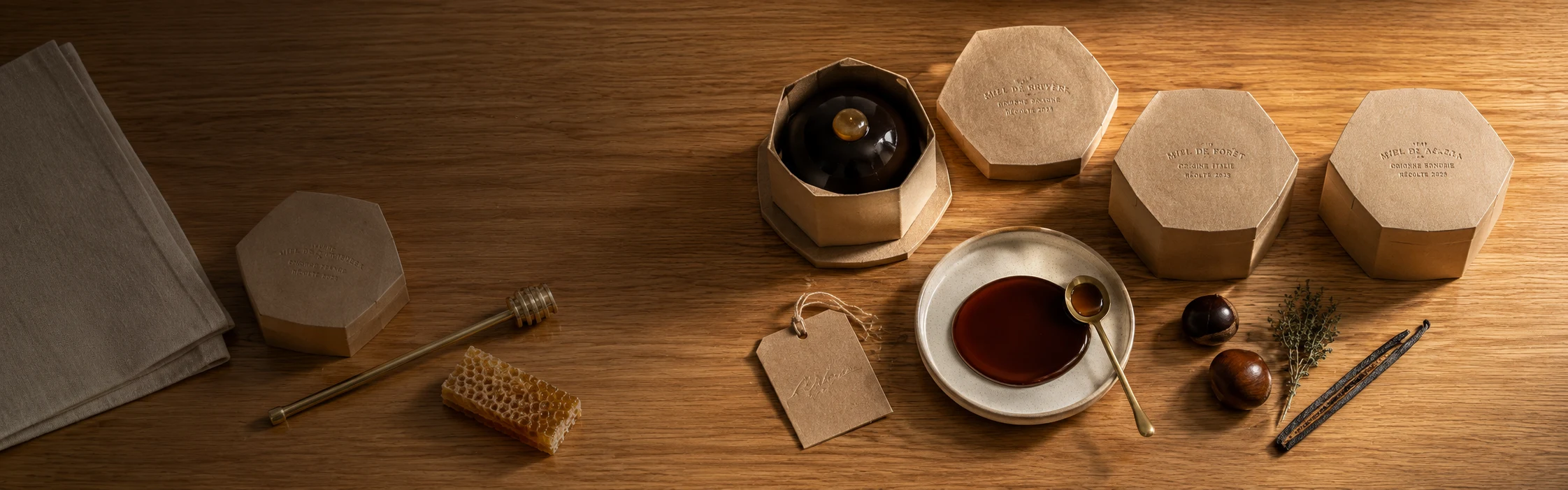
A guiding line, before the trends: the Maison's pieces are shaped by what is inside them. A honey gâteau takes its form from honey. A cacao composition takes its form from cacao. The piece does not borrow shape from a fruit it is not, a colour the year is naming, or a texture the feed has been training the audience to expect. The form is downstream of the ingredient.
This sounds obvious. It is not. Most of what the year calls a trend is a shape given to pastry from outside the bench — by a forecast, by an algorithm, by another chef's vocabulary that has become a style. Reading 2026 from the bench is, mostly, the work of sorting those two directions apart.
Four currents the materials ask for
Some of the year's strongest currents come from inside the work itself.
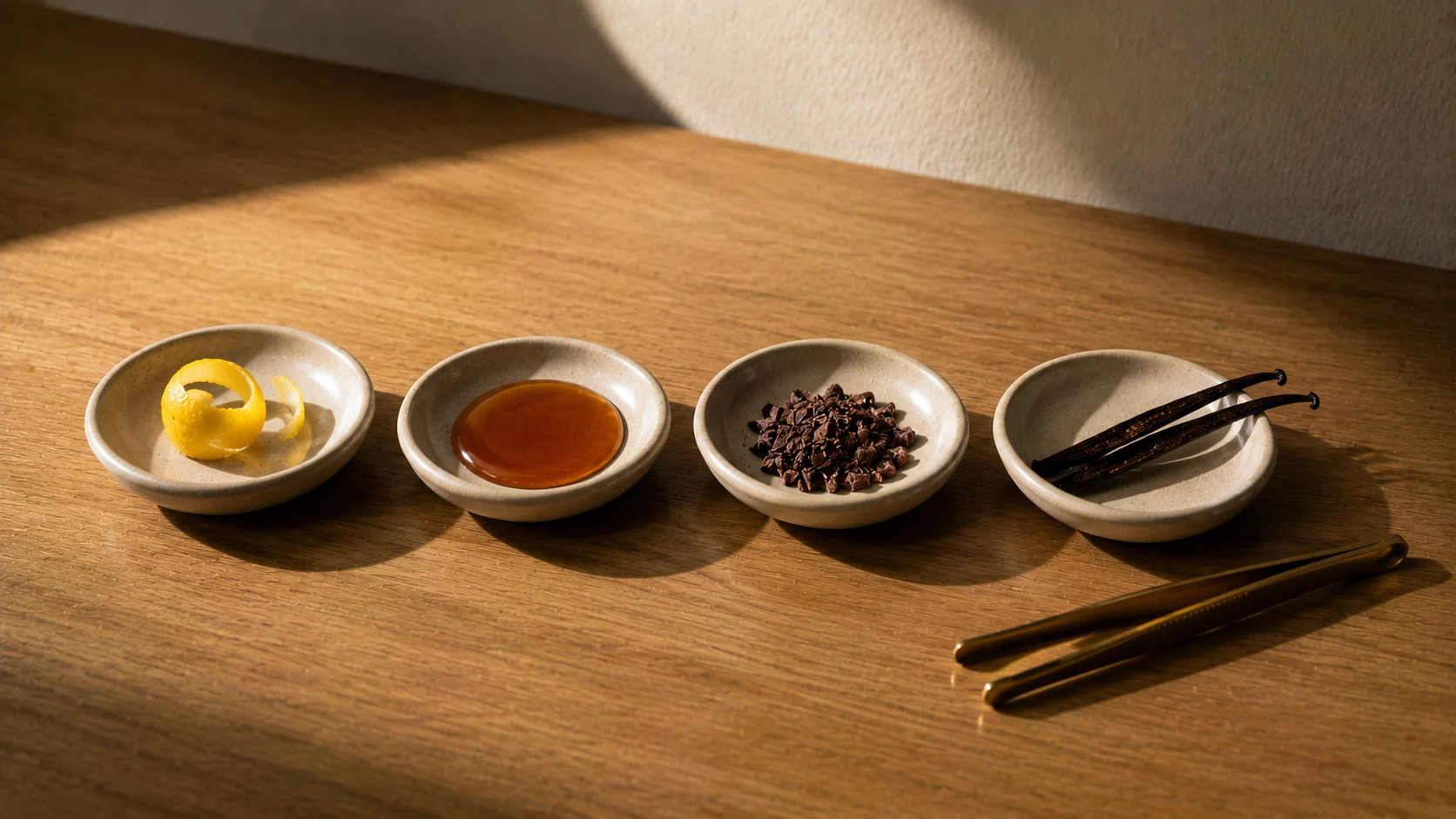
Brightness over weight. Lemon, yuzu, raspberry, bergamot. Citrus zest leads every regional flavour forecast for 2026; tangy notes are what the year's audience asks for. The reading is not "less sugar" — it is acidity carrying the sweetness. Single-origin honey is built on this question: orange-blossom reads like a citrus, sourwood almost like a tea, chestnut brings its own woody bitterness. Honey itself argues the trend.
Texture as composition, not stunt. Industry surveys put texture as the primary source of pastry pleasure for over seventy percent of consumers worldwide. The risk is the contrast-for-contrast piece: crispy over chewy over creamy, assembled because the feed rewards it. A composition is texture in service of a single ingredient's argument. The praline crunch under the dome is there because the honey on top needs it, not because the algorithm does.
Smaller, better. About two-thirds of premium consumers now prefer fewer pieces at higher quality over larger pieces at the same price. This is what the trade calls premiumisation. It is also what the capsule has always been. Quality scales down better than it scales up; the year's audience is choosing what the capsule was already composed to give.
Named provenance, narrated practice. Valrhona completed plot-level traceability of its cocoa purchases in 2024. Single-origin chocolate is no longer specialty; it is the floor of the premium segment. Across honey, dairy, vanilla, cacao, the same is true. Naming the producer — the apiarist, the dairy, the farm, the year of harvest — is what allows the work to be read. The story is not a marketing layer over the piece; the story is what makes the piece legible. A guest who knows whose honey is inside the gâteau tastes the gâteau differently.
These four currents are the year's substance. They will outlast the year.
Four currents the materials do not ask for
There are equally visible 2026 currents that come from outside the bench. The Maison watches them and lets them pass.
Trompe-l'œil fruit. Cédric Grolet's lemons, peaches, apples are the technique of a master who built that language; it is his vocabulary, fully. A second-line maison adopting it is working in someone else's grammar. The Maison will not make pastry shaped like fruit. The Maison will make pastry shaped like honey, or shaped like cacao — pastry whose form expresses what is inside it.
The Pantone year-colour. Cloud Dancer 11-4201 is forecast as 2026's pastry palette. The Maison's palette is unbleached kraft and graphite; we do not change it because a colour committee has named the year.
Viral texture mashups. Crispy-chewy-creamy is the algorithm's preferred grammar. It is also the grammar of a pastry chosen for its scroll-stopping reel, not for the ingredient at its centre. The Maison composes textures around an ingredient, not around the camera.
The breakfast hour. Sourdough crossover into sweet pastry, viennoiserie hybrids, laminated everything — one of the year's loudest currents, and one the Maison has explicitly refused. The morning belongs to the bakery. The Maison does the evening.
What stays when the trends move
When trends move toward a practice — and 2026 is moving toward the maison de saison practice — the exterior of the practice becomes easy to imitate. The unbleached kraft cell can be copied. The seven-piece monograph can be copied. The named producer can be copied.
What cannot be copied is the long version of the work. The season composed in advance. The slow methods kept when faster ones would do. The chef's hand finishing every piece. The archive closed when the season closes. These are not strategy. They are practice — done over years, in a kitchen, by one hand.
The trends will move on; next year's forecast is already being written. The work, kept honestly, stays where the materials are.
The work ahead
Le Rucher opens September 2026 as a monograph on seven single-origin honeys. The second capsule, in winter, will be composed around cacao — and cacao in 2026 is the most legible test of the Maison's principles, because every claim that matters there (origin, fermentation, harvest, maker) is what the year has come to demand and what the Maison was built to do.
The capsules of 2027 will speak in their own seasons. None of them will let a year's vocabulary set the Maison's. The form, in every case, will be downstream of the ingredient — because that is the only shape the work can honestly take.
More from the journal — read on.