Le Rucher — a monograph on seven single-origin honeys
An introduction to the maison's debut capsule — seven varietals, seven creations, one ingredient followed to its end.
The maison's debut capsule is a question, posed in seven pieces, about what a single ingredient can do when nothing else competes with it.
Le Rucher — French for the apiary, the apiarist's bench, the row of hives at the edge of a field — opens on September 1, 2026 and closes on October 31, 2026. The capsule contains seven creations, one for each of seven single-origin honeys, composed to reveal the terroir of one apiarist, one field, one slope at a time.
Honey is the subject. Not the sweetener.
The premise
Most pastry treats honey as a substitution. It replaces refined sugar, lightens a glaze, sweetens a ganache. It is rarely studied in itself. The chef knows that buckwheat is darker than acacia; the chef does not, in the ordinary kitchen, build seven different creations to surface what makes each one its own register on the tongue.
Le Rucher is the case for building those seven creations.
A single varietal of honey is the product of bees foraging in a specific landscape, over a specific window of weeks, in a specific year. It is not a flavor; it is a record. Acacia from a Hungarian forest is a different substance from acacia from a Vermont valley, even when the bees and the flower are technically the same. The varietal names a category. The apiary names the work.
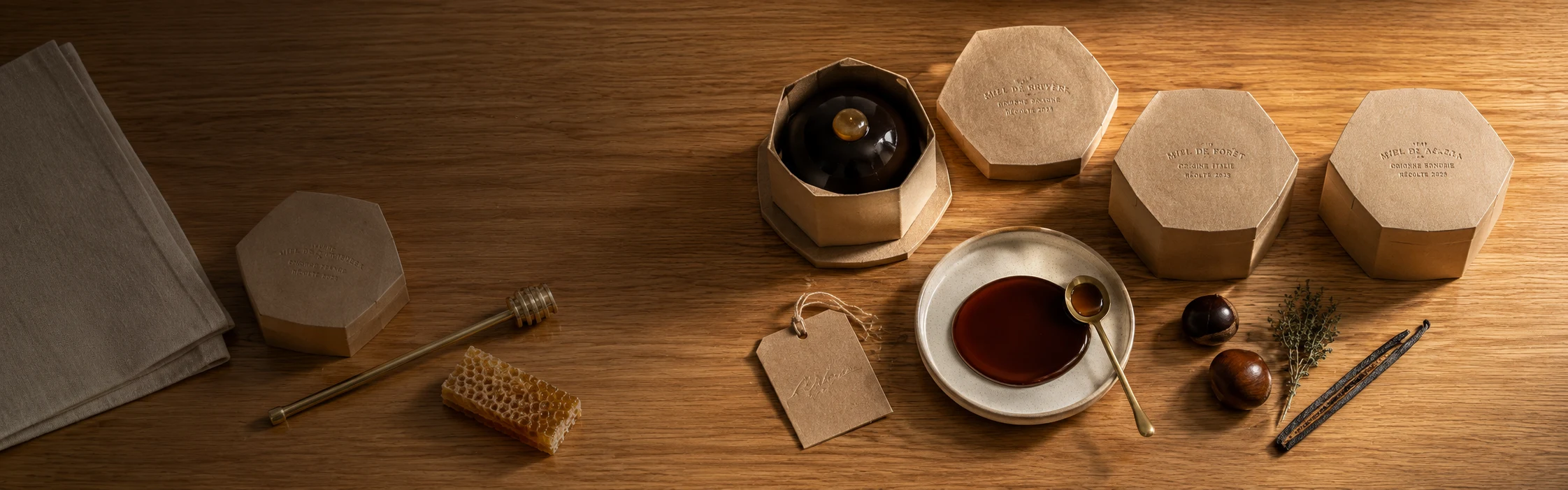
The capsule's structure makes the apiary visible. Each cell of the capsule's hexagonal packaging carries, debossed into the kraft, four pieces of information: the varietal of the honey, the GPS coordinates of the apiary, the year of harvest, and the name of the apiarist. None of these is decorative. All of them are commitments.
The seven études
The seven creations are arranged as a tasting flight — light to dark, transparent to opaque, opening to closing.
Étude N° I — Buckwheat · Honeycake Noir
The capsule's flagship. Buckwheat honey is the darkest of the seven — mineral, almost licorice, with notes of tobacco and burnt molasses. It is the honey most people have either never tasted or remember with a wince; tasted alone, it is uncompromising. We caramelize it for eight to ten hours, until its character deepens into something nearly bitter.
The form is a fully mousse honeycake on a hexagonal oak plinth: rye-buckwheat sourdough sponge, smoked black-currant crémeux, pecan-bourbon praline, the whole thing finished in a velvet of burnt-wood tone. The name, and one drop of gold — the apiarist's seal. Nothing else.
Étude N° II — Acacia · Pavlova Diaphane
The opposite register. Acacia is the lightest, most transparent honey — floral, almost weightless on the tongue. The form is a French meringue nest whipped on acacia held as a hydrolyzed syrup — a technical note only professionals will catch — with mascarpone ganache, a single Madagascar vanilla, yuzu curd for acid counterpoint, and one cornflower petal. Refined sugar appears nowhere in it.
Étude N° III — Chestnut · Forêt d'Octobre
The architectural piece. Chestnut honey is bitter, tannic, almost leather. The dilettante's least favorite; the sommelier's most. The form is an entremet — mousse on white chocolate infused with chestnut honey, vanilla crémeux insert with Italian marron-confit, chestnut-flour dacquoise. Velvet in wet-bark tone. One glazed chestnut, one leaf of gold.
Étude N° IV — Thyme · Garrigue · one bite
The answer to the Korean one-bite cakes that were ubiquitous in 2025. Two halves of French meringue made on Greek thyme honey — herbal, warm, slightly resinous — with a crémeux on sheep yogurt and quince confit between them, and a pinch of piment d'Espelette. Heat that comes from Basque pepper and thyme, not from caramel or chili.
Étude N° V — Lavender · Hojicha & Provence
The cultural collision. Provence lavender honey meets Japanese roasted hojicha. A choux glazed with makrut lime essential oil, lavender-honey craquelin, hojicha crémeux, black sesame crumble. The reverse of the Dubai-chocolate dessert that dominated 2024: the West read through the lens of the East, instead of the other way around.
Étude N° VI — Manuka MGO 400+ · Wellness Bonbon
A box of nine. Single-origin Madagascar 70% chocolate shell, ganache on manuka honey at MGO 400 or above, with a fermented kefir note — probiotic indulgence. A plant-based variant on tahini, identical in taste. Functional luxury, without greenwashing. Manuka works; the MGO label does half the press.
Étude N° VII — Pine honeydew · La Ruche
The capsule's closing piece. Pine honeydew is, on the tongue, almost not honey at all — resinous, dark, almost umami. The form is a sphere the size of an apple. Outside: milk-chocolate glaze textured to read as bark. Inside: mousse on pine honeydew, dark-chocolate ganache with porcini for umami resonance with the resin note, rye-pine sponge. Three chocolate needles. One sugar drop — resin. Served under Highland Park 18, or genmaicha, in cases where it is plated.
Why this capsule, why now
The maison opens with a monograph capsule rather than a mixed one because the debut needs to be unambiguous about what kind of practice this is. A mixed capsule — three classical pieces, two signatures, two reinterpretations — would be a safer first season. It would also be every other artisanal pastry house in Houston.
A monograph announces a method: one ingredient, seven studies, the discipline of composing seven times against the same material. It is the kind of work that asks the maker to know the ingredient more deeply than she would know seven different ingredients. For the debut, this is the right form.
The capsule is also a bet on a market window. Single-origin as a frame is mature in coffee, in chocolate, in wine. It is not yet mature in honey, at the consumer level. The chef working in single-origin honey in 2026 is, in some small way, doing what specialty coffee was doing in 2010. There is room to build a tradition while the term is still being defined.
What follows Le Rucher
The Vespre's standard capsule cadence is five capsules a year — Hiver, Spring, Summer, Fall, Holiday. Le Rucher is the Fall 2026 capsule. The Holiday 2026 capsule follows in November, and it will not be a monograph. Future Falls return to a mixed format. Le Rucher is the only honey monograph the maison will release in this format.
If it returns to honey in the future, it will return differently — a different region, a different question, a different seven. The discipline of the maison is that the capsule does not repeat.
Reservations
The full capsule is available as the Ruche — a block of all seven hexagonal cells, sold as a single object, for guests who want the complete tasting flight. Individual cells are also available, with each étude orderable on its own.
Reservations open on September 1, 2026 at 12:00 Central. The waitlist sees the announcement first. Boxes are produced in counted runs, in sequence, across the eight weeks of the capsule. Pickup is by appointment at our Houston address. In-state Texas shipping is available where the form allows; out-of-state shipping is not permitted under the maison's current cottage food framework.
The full capsule page, with each étude in detail, opens with the capsule.
For now, the waitlist is the door. Four sends a year, no more.
More from the journal — read on.